
Have you ever received a message like “IMA call you later” or “IMA get something to eat” and wondered what IMA means? This expression is common in casual online conversations, but its spelling can make it confusing, especially if you are unfamiliar with modern texting slang.
The good news is that the meaning is quite simple. IMA is an informal way of writing “I’ma,” which usually means “I’m going to.” People use it to express an intention, describe something they plan to do, or explain their next action.
Understanding the IMA meaning slang can make it easier to follow conversations on social media and messaging apps. Let’s explore its meaning, common uses, and examples.
Quick Answer: What Does IMA Mean in Text?
IMA usually means “I’m going to” in texting and internet slang.
It is a casual variation of “I’ma” or “Imma,” used mainly in informal conversations.
For example:
- “IMA call you tonight” means “I’m going to call you tonight.”
- “IMA buy some new shoes” means “I’m going to buy some new shoes.”
- “IMA finish this work” means “I’m going to finish this work.”
The expression communicates an intention or something a person plans to do.
What Does IMA Stand for in Texting?
Unlike many texting abbreviations, IMA is not usually an acronym in which every letter represents a separate word. Instead, it is a phonetic spelling of an informal spoken expression.
In everyday American English, people often pronounce “I’m going to” as “I’ma.” Over time, this spoken form became common in casual writing, including text messages, social media posts, and online chats.
For example:
Standard English: I’m going to watch a movie tonight.
Casual texting: IMA watch a movie tonight.
Both sentences communicate the same basic idea, but the second sounds more relaxed and conversational.
You may also see IMA written as “I’ma” or “Imma.” These forms are closely related and generally carry the same meaning.
IMA vs IMMA vs I’ma: What’s the Difference?
You might wonder why people use different spellings for the same expression. The difference is mostly stylistic rather than grammatical.
| Form | Meaning | Common use |
|---|---|---|
| IMA | I’m going to | Casual texting |
| IMMA | I’m going to | Informal chats |
| I’ma | I’m going to | Informal writing |
| Gonna | Going to | Everyday conversation |
| I’m going to | Expressing an intention | Standard English |
For example:
- IMA go home now.
- IMMA go home now.
- I’ma go home now.
- I’m going to go home now.
All four communicate a similar intention, although the first three are more informal.
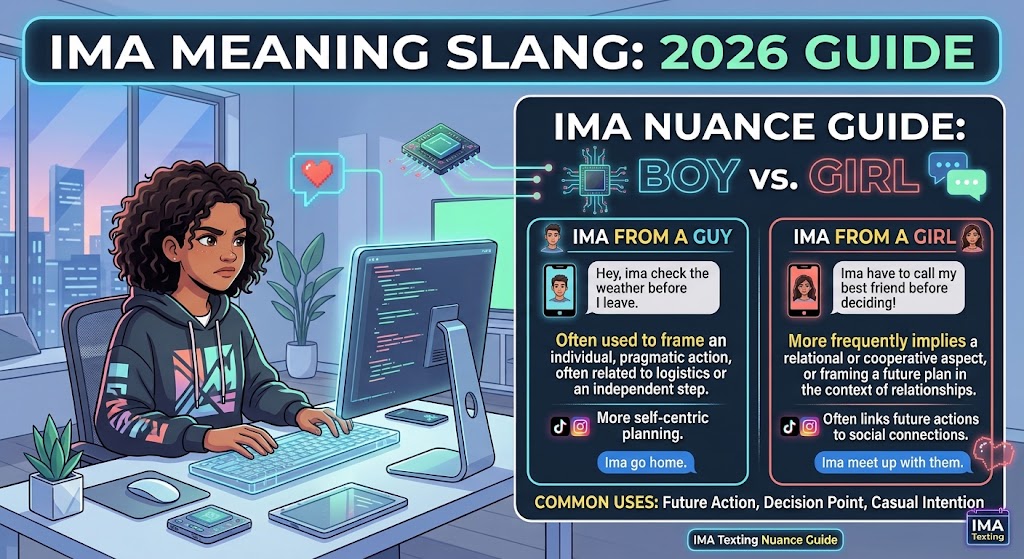
IMA Meaning in Text From a Girl or Guy
Does IMA have a different meaning depending on who sends it? No. The basic meaning stays the same regardless of the sender’s gender.
However, the rest of the message can reveal what the person intends to do.
IMA meaning from a girl:
- “IMA text you when I get home.”
- “IMA watch that movie tonight.”
- “IMA tell you something later.”
IMA meaning from a guy:
- “IMA call you after work.”
- “IMA play football tomorrow.”
- “IMA grab some food.”
In both cases, the sender is talking about a future action.
If someone texts you “IMA miss you,” the message expresses an intention or feeling in an informal way. The emotional meaning comes from the complete sentence, not from IMA itself.
What Does IMA Mean on Snapchat, Instagram, TikTok, and WhatsApp?
IMA generally has the same meaning across popular social media platforms. It does not have a special definition on one particular app.
| Platform | Example | Meaning |
|---|---|---|
| Snapchat | “IMA send you a snap” | I’m going to send you a snap |
| “IMA post this later” | I’m going to post this later | |
| TikTok | “IMA try this trend” | I’m going to try this trend |
| “IMA call you tonight” | I’m going to call you tonight |
People use these informal expressions because they sound natural in quick conversations.
You may also encounter IMA in comments, captions, private messages, and social media discussions.
How to Use IMA in a Text Message
Using IMA is straightforward. Place it before an action to explain what you intend to do.
Here are some everyday examples:
1. Making plans
“IMA visit my friend this weekend.”
Meaning: I’m going to visit my friend this weekend.
2. Talking about food
“IMA get a pizza.”
Meaning: I’m going to get a pizza.
3. Expressing determination
“IMA work harder next time.”
Meaning: I’m going to work harder next time.
4. Making a promise
“IMA help you with your homework.”
Meaning: I’m going to help you with your homework.
5. Ending a conversation
“IMA sleep now. Goodnight!”
Meaning: I’m going to sleep now.
These examples show that IMA can fit naturally into many types of casual conversations.
How to Respond When Someone Says IMA
Your response depends on what the person plans to do. Usually, a simple and friendly reply is enough.
| Their message | Possible response |
|---|---|
| “IMA call you later.” | “Okay, talk soon!” |
| “IMA go shopping.” | “Have fun!” |
| “IMA visit tomorrow.” | “Looking forward to it!” |
| “IMA try that game.” | “Let me know how it goes.” |
| “IMA sleep now.” | “Goodnight!” |
You do not need to use slang in your reply. A normal sentence works perfectly well.
Is IMA Rude in Texting?
No, IMA is not considered rude by itself. It is simply an informal way of expressing a future intention.
However, it may not suit every situation. For example, using IMA in a formal business email, academic assignment, or professional report can sound too casual.
Use IMA with friends, family, and people who are comfortable with informal communication. In professional settings, choose “I’m going to” instead.
Related Texting Slang You Should Know
If you understand IMA, you may also find these popular internet expressions useful.
| Slang | Meaning |
|---|---|
| IMMA | I’m going to |
| GONNA | Going to |
| WANNA | Want to |
| FINNA | About to / preparing to |
| LEMME | Let me |
| GIMME | Give me |
| IDK | I don’t know |
| TBH | To be honest |
| FR | For real |
| NGL | Not gonna lie |
These expressions are common examples of informal language used in digital communication.
Frequently Asked Questions (FAQs)
1. What does IMA mean in a text message?
IMA usually means “I’m going to.” It is an informal expression used when someone talks about an action they intend to take.
2. Does IMA mean I’m going to?
Yes. In casual texting, IMA is commonly used as a shortened written form of “I’ma,” meaning “I’m going to.”
3. What does lowercase ima mean?
Lowercase “ima” has the same meaning as uppercase IMA. Capitalization does not normally change its meaning.
4. Is IMA Gen Z slang?
IMA is used in modern casual texting, including by younger social media users. However, the spoken expression is not exclusive to Gen Z and has a longer history in informal American English.
5. Can IMA have a romantic meaning?
IMA does not have a specific romantic meaning. Someone might use it while talking to a partner or crush, but its basic meaning remains “I’m going to.”
6. Is IMA the same as IMMA?
Yes. IMA and IMMA are informal spelling variations of the same expression. Both generally mean “I’m going to.”
7. Can I use IMA in professional messages?
It is better to avoid IMA in formal communication. Use “I’m going to” or “I plan to” when writing professional emails and business messages.
8. Why do people use IMA in chat?
People use IMA because it reflects natural casual speech and makes messages feel relaxed. It is also shorter than writing the complete expression.
Conclusion
The IMA meaning slang is simple: it usually means “I’m going to.” People use it in text messages, social media conversations, and everyday online communication to describe something they plan to do.
You might see IMA, IMMA, or I’ma on Snapchat, Instagram, TikTok, and WhatsApp. Although their spelling differs, they generally communicate the same idea.
Remember that IMA is an informal expression, not a suitable replacement for standard English in every situation. Use it naturally with friends and in casual chats, and choose the full phrase when a more professional tone is needed.

